The Copper Constraint: Why AI Infrastructure Needs Biology to Scale
I have to admit, I didn’t know “mining microbes” were a thing until recently. Now I’m an investor.
One of the best parts about moving from building to investing is the permission to explore problems completely outside my domain. The learning curve is steep, but pattern recognition transfers well. The search for “what works” feels surprisingly similar, even when the subject matter is new.
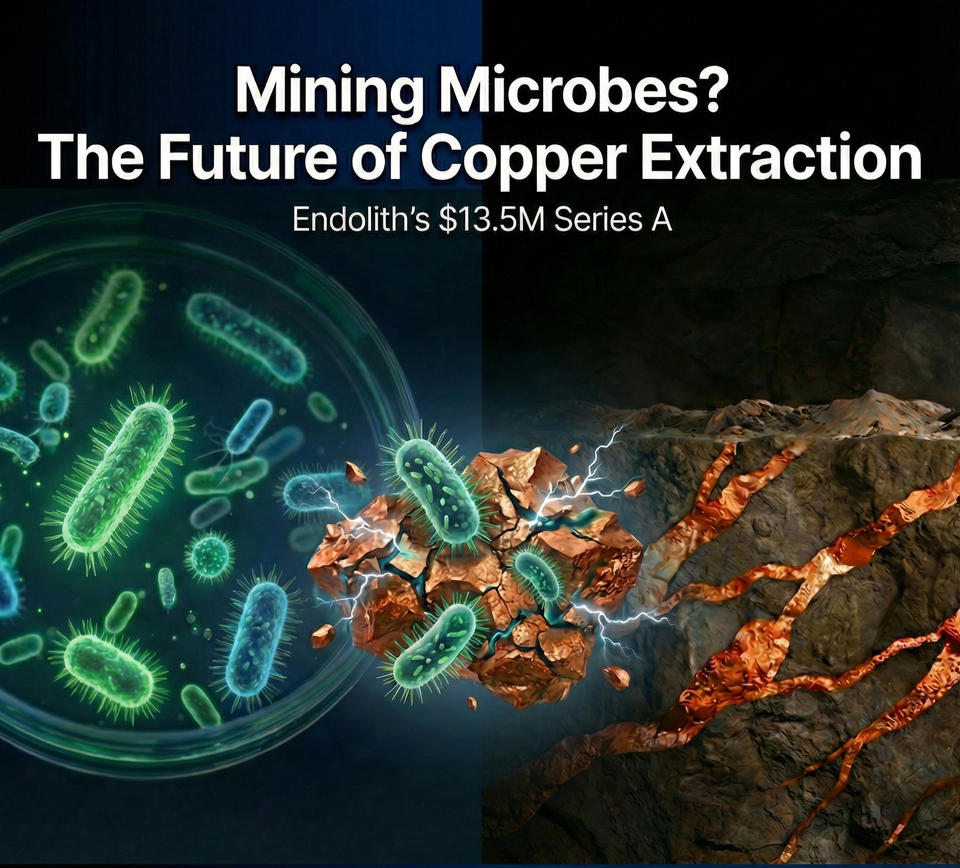
I recently invested in Endolith via Gaingels. They use engineered microbes to extract copper from ore; basically using biology to do the heavy lifting where traditional chemistry stalls.
Here is why this matters more than it might seem at first glance.
The Copper Constraint
You can’t have the AI boom without building out the underlying physical infrastructure. There are massive, looming bottlenecks in the physical layer though. One example: Copper.
Copper isn’t just needed for the data centers buildout themselves. The grid infrastructure to support this buildout - substations, transformers, transmission lines - is all copper-intensive with current projections suggesting data centers could consume up to 9% of total US electricity by 2030 (up from ~4% today).
The result: S&P Global projects global copper demand will nearly double by 2035.[^1]
We have already mined the “easy” stuff. What remains are lower-grade ores (often <0.5% copper). The extraction chemistry still works but as the grade quality drops, you have to process significantly more rock to get the same output.
Enter Biology
This is where Endolith changes the equation.
Founded by Dr. Liz Dennett, Endolith uses engineered microbes that naturally accelerate copper extraction. These aren’t generic bacteria. They are specifically optimized strains that thrive in harsh mining environments.
The mechanism is elegant: the microbes catalyze reactions that traditional acid leaching can’t achieve efficiently.
This approach has demonstrated the ability to increase copper yield by 30-90% compared to standard sulfuric acid leaching.[^2]
Think about the unit economics. A mine has already paid the CapEx for the land, the equipment, and the labor. If you can apply a biological layer that extracts 30-90% more value from the rock you are already processing, nearly all of that falls to the bottom line.
Why Now?
The timing is driven by a simple reality: desperation breeds adoption.
When copper demand is projected to double while ore grades quality deteriorates, technologies that were previously viewed as “science projects” are becoming strategic necessities.
The Broader Pattern
This fits into a thesis I’ve been developing: When digital solutions hit physical constraints, the innovation moves to adjacent disciplines.
Software optimized logistics, but it can’t conjure copper out of thin air. AI can optimize datacenter power usage, but it still needs physical wires to run on. At some point, the digital economy hits the physics layer.
Many of the companies emerging now are working at this intersection: using biology, materials science, and robotics.
The challenge, though, is that these aren’t just science experiments - they are massive process engineering challenges. Biology can work well in a Petri dish, but scaling biological systems to industrial volumes is notoriously difficult.
The execution risk, therefore, is real. It is also exactly where I spend my time digging in. Using my engineering background to separate the science projects from the scalable ones.
Endolith is a clear example of a team tackling this head-on. They aren’t a mining company that bolted on some tech. They are a biotech company applying biochemical efficiency to an infrastructure problem.
Final Thought
Six months ago, I wouldn’t have predicted I’d be learning about bioleaching. But the best opportunities often come from the edges of what you already know.
The infrastructure boom isn’t just about building more. It’s about building smarter - using tools and technologies that didn’t exist a decade ago. Endolith is one of those enablers.
And I’m betting this won’t be the last time biology shows up in my infrastructure thesis.
[^1]: S&P Global, “The Future of Copper: Will the Looming Supply Gap Short-Circuit the Energy Transition?” (July 2022).
[^2]: How this Startup Taps Critical Minerals Typically Uneconomical to Mine (June 2025)